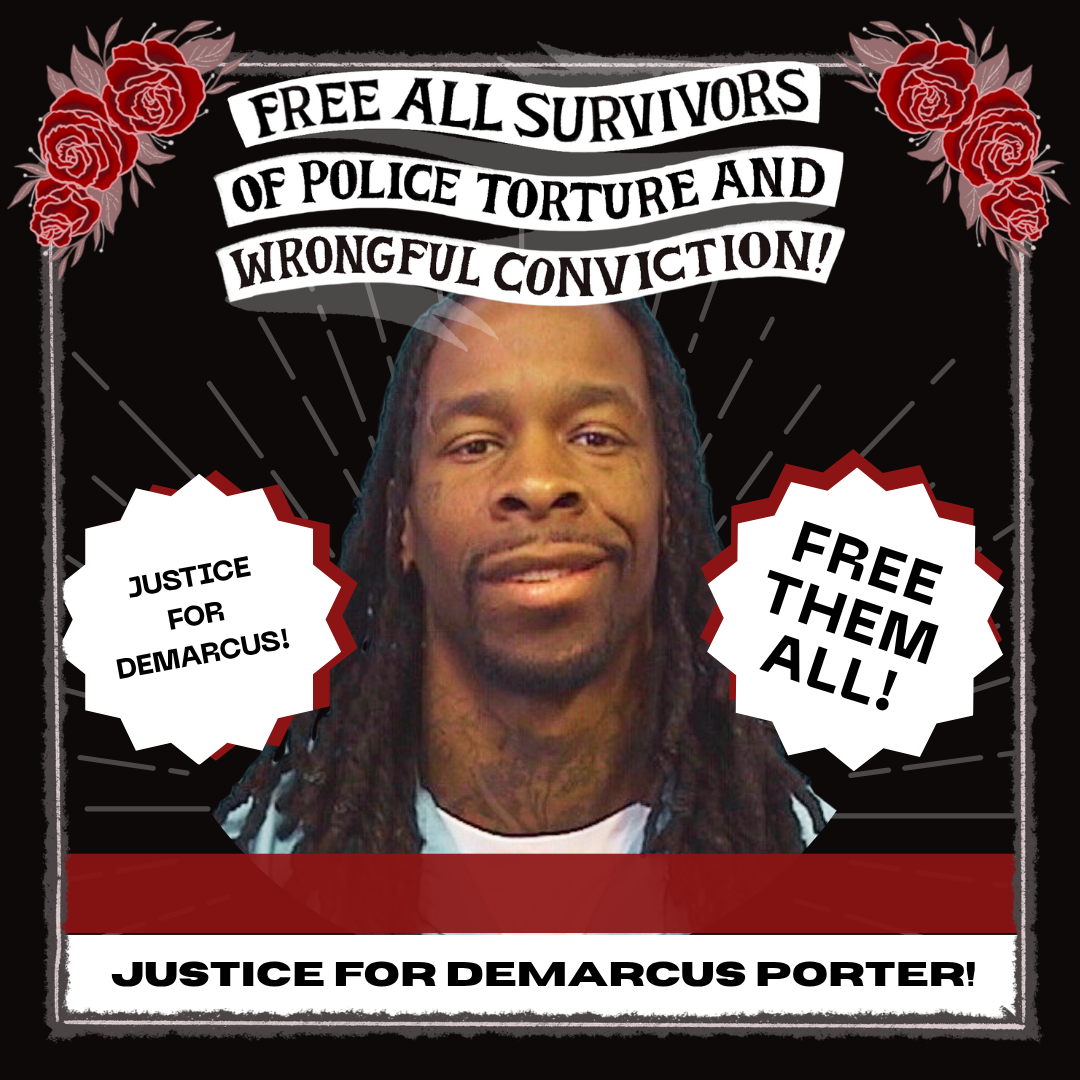
Framed on a murder charge by police through torture
Under oath, the victim’s uncle testified that Demarcus Porter was not the person who shot the victim.
The following is based on the Illinois Appellate Court decisions in People v. Porter, Cook County case 14 CR 12787, along with the underlying trial facts. The case concerns the June 22, 2014, shooting of Brian Bedford in Chicago.
Victim identified Porter — but did not identify him in court
Brian Bedford was shot 12 times on June 22, 2014, near 69th Street and Talman Avenue in Chicago. Bedford testified that three-armed men approached him and one of them opened fire from approximately two feet away.
According to Bedford, the shooter's face was partially covered by a T-shirt. Bedford said he could see only part of the shooter's face, including the eyes and facial tattoos resembling the numbers “7” and “2.” He also acknowledged that he knew several people with that tattoo.
The victim testified that several individuals shared the same tattoo. When specifically asked whether anyone else had the same tattoo, the victim responded, ‘Suave.’ Despite this testimony, no other individual identified as having the same tattoo was charged.
Porter was eventually identified as the alleged shooter, known by the nickname “Hustle.”
But there was an important conflict at trial: Bedford did not identify Porter as the shooter in the courtroom. When asked whether he saw one of the three individuals in court, Bedford answered no.
The identification
The day after the shooting, detectives visited Bedford in the hospital.
Bedford wrote:
“Hustle Porter”
and wrote that authorities should try to get him before Bedford did.
On June 26, detectives showed Bedford a photographic lineup. Bedford selected Porter's photograph and wrote “He shot me” on the photograph.
On July 2, Bedford gave a written statement to a detective and two assistant state attorneys. He identified Porter's photograph and labeled it “Hustle Demarcus Porter.” Bedford said that he recognized the shooter by the facial tattoos.
These earlier statements became extremely important because Bedford's trial testimony did not provide an in-court identification of Porter.
No forensic evidence tied Porter to the shooting
The prosecution did not present forensic evidence connecting Porter to the shooting.
The 2024 Illinois Appellate Court decision specifically described the case as one in which “no forensic evidence tied defendant to the crime” and there was no confession. The court stated that the State's case relied on the identification evidence concerning Bedford.
There were also no other eyewitnesses who testified that they saw Porter commit the shooting.
Porter maintained he was innocent
Porter denied shooting Bedford.
At trial, he testified that he was not responsible for the shooting. The defense challenged the reliability of Bedford's identification and argued that the evidence was insufficient to establish that Porter was the shooter.
The defense also challenged the admission of a recorded telephone call Porter made while in custody.
Conviction
Porter was tried in a bench trial, meaning the judge rather than a jury determined his guilt.
The trial court found him guilty of:
Six counts of attempted first-degree murder
Aggravated discharge of a firearm
Aggravated battery
The six attempted murder findings were ultimately merged, and Porter received three concurrent 31-year sentences for attempted first-degree murder.
2020 appeal
Porter appealed his conviction, arguing that the evidence was insufficient because Bedford did not identify him in court and because Bedford's earlier statements were unreliable.
The Illinois Appellate Court nevertheless affirmed the convictions in February 2020.
The appellate court held that Bedford's earlier identifications, including the handwritten identification, photographic lineup, and signed statement, could be considered by the trial court. The court concluded that, viewing the evidence in the light most favorable to the prosecution, there was sufficient evidence to support the conviction.
Post-conviction challenge
Porter subsequently filed a post-conviction petition.
He argued, among other things, that his trial attorney had been ineffective for failing to:
seek suppression of Bedford's identification; and
present an expert concerning the reliability of eyewitness identification.
The trial court summarily dismissed the petition at the first stage.
2024 appellate ruling
A significant development occurred on December 31, 2024.
The Illinois Appellate Court reversed the summary dismissal of Porter's post-conviction petition and sent the case back to the circuit court for second-stage proceedings.
Importantly, this rule did not declare Porter innocent or overturn his conviction. Instead, the appellate court determined that his post-conviction claims were sufficient to proceed beyond the initial screening stage.
The court highlighted several circumstances concerning the identification, including that the shooter's face was largely concealed, and Bedford could see only a portion of the face, including the eyes and the “7” and “2” tattoos.
The central issue
The central question in Porter's case is therefore not simply whether Bedford identified Porter at some point.
He did identify Porter before trial.
The much more significant issue is the reliability and circumstances of that identification, because:
Bedford's view of the shooter was partially obstructed.
Bedford did not identify Porter in court.
Bedford knew multiple people with similar “7” and “2” tattoos.
There was no forensic evidence tying Porter to the shooting.
There was no confession.
No other eyewitness testified that Porter was the shooter.
Porter's post-conviction petition raised questions about the identification procedures and the failure to present expert testimony concerning eyewitness reliability.
Current procedural significance
As of the December 2024 appellate decision, Porter's conviction had not been vacated. The appellate court ordered the post-conviction case to proceed to the second stage, giving Porter an opportunity to litigate his claims further.
Case:People of the State of Illinois v. Demarcus Porter
Cook County case:14 CR 12787
Underlying shooting: June 22, 2014
Victim: Brian Bedford
Conviction: Attempted first-degree murder and related firearm/battery offenses
Sentence: 31 years, concurrent sentences
Direct appeal: Conviction affirmed in 2020
Post-conviction appeal: Summary dismissal reversed and case remanded for second-stage proceedings in 2024.
Official Illinois Appellate Court 2020 decision
Official Illinois Appellate Court 2024 decision
One important correction to the earlier description: this Demarcus Porter case was not a case where multiple eyewitnesses testified at trial that Porter wasn't the shooter, as in the Antonio Porter case you passed. Here, the prosecution's identification evidence principally came from Brian Bedford's pretrial identifications, while Bedford did not identify Porter in court. The 2024 appellate ruling nevertheless found enough merit in Porter's post-conviction claims to require further proceedings.