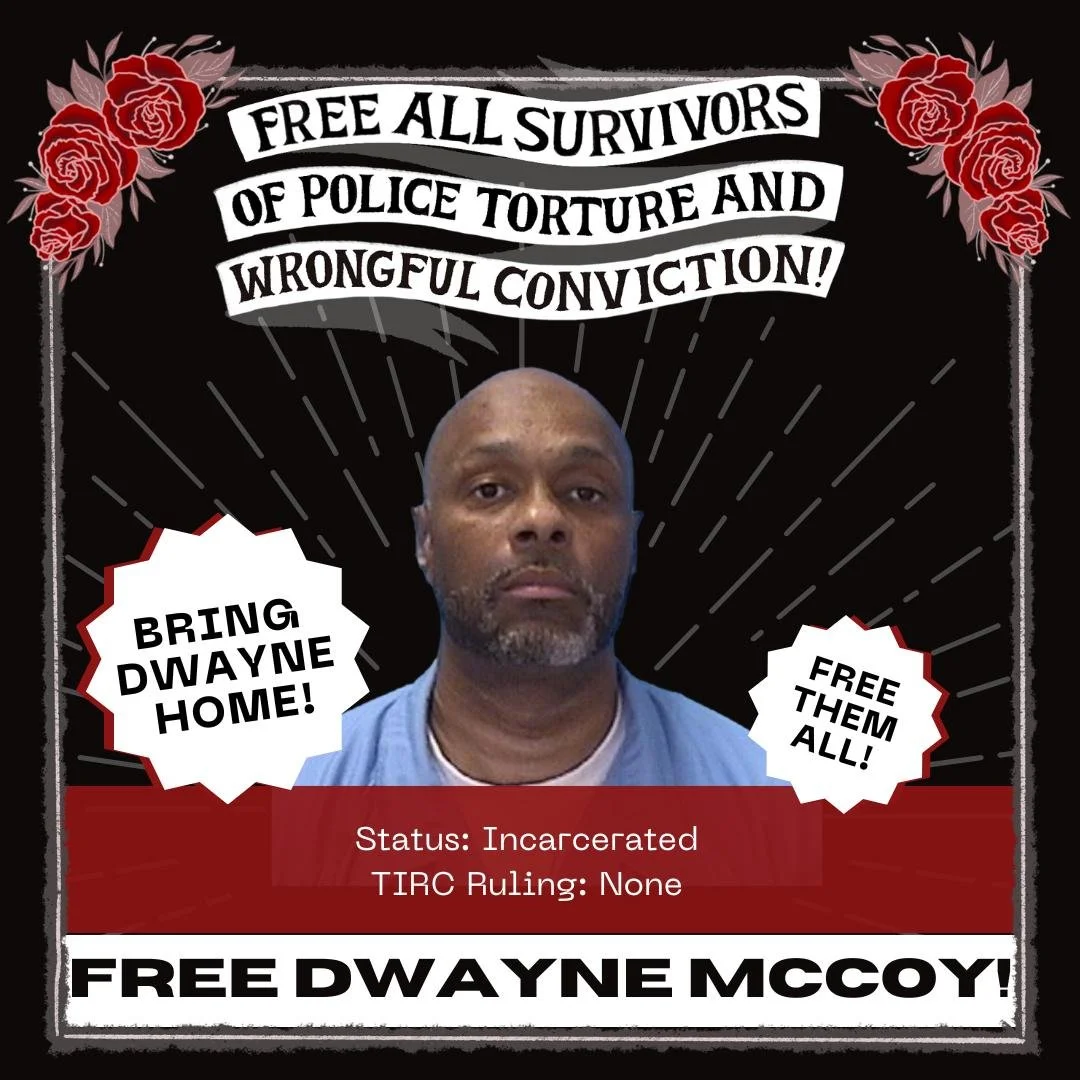
In 2004, Dwayne McCoy, in a trial marked by serious procedural errors and allegations of witness coercion, was sentenced to 65 years in prison for First Degree Murder and firearm enhancement. The conviction has since been called into question due to subsequent witness recantations, claims of inadequate legal representation, and most importantly, new evidence of Dwayne's innocence.
After several timely appeals that were ultimately denied, in 2023 Dwayne requested the court grant Leave to File his Pro se Successive Post-Conviction petition based on claims of “Actual Innocence” for Second - Stage proceeding.
Factual background on the trial
Dwayne was found guilty of First Degree Murder subsequent to a bench trial before Lawrence P. Fox. Two problematic aspects of Dwayne's trial particularly call into question his 65 year sentence. First, there are several questionable elements in the testimonies of the state’s eyewitnesses. Second, Dwayne’s defense did not give him adequate access to important information that could have impacted the trial.
The state presented two eyewitnesses, Thurman Wade and Anthony Philips, who argued that Dwayne shot Jovan Day.
The state's main witness, Thurman Wade, testified that on March 2nd, 2000, he was in the car with McCoy, Jovan Day, and Anthony Phillips. While in the car, the four men drove around drinking whiskey and smoking marijuana. Wade testified that at some point Day vomited on himself and needed to get out of the car. McCoy, who was allegedly driving, stated that he was too drunk to drive. Day volunteered to drive, and the two got out of the car to change places. According to Wade, as Day walked to the front of the car McCoy shot Day. At which point McCoy allegedly got back into the car and drove off with Wade and Phillips.
The state’s second eyewitness, Anthony Phillips, testified that he was in the car with McCoy, Day, and Wade on the night of the shooting. Philips recounted a similar series of events, while also noting that McCoy and Day did not argue, and were toasting to new friendships on the day of the shooting. He also added the detail that Day threw his jacket on the hood after he started vomiting.
The defense presented the only witness that was a “scene witness” and not associated with Phillips, Day, McCoy, or Wade on the night of this incident. Mr. Comell Owens testified that he was leaving his apartment at 4507 West Van Buren between 2:30 and 3:00am with his friend to go to a restaurant. Mr. Owens identified McCoy ‘as a person who asked him for a cigarette, at the corner of Glady’s’. Mr. Owens also testified that he saw three guys on Glady’s, which was a high-drug area. Owens testified that he saw a man running who was carrying a shiny small silver gun. Mr. Owens testified that he came within four to five feet from him, and he saw this man shooting at a guy with no shirt on. Mr. Owens testified the shooter was not McCoy, he never saw McCoy with a weapon. On cross-examination, Mr. Owens testified that he remembers March 2nd, 2000 as the night of the shooting.
In rebuttal, the state called Kaya Washington who testified that she was ten or eleven years old at the time of the shooting. At trial, she was 16 years old. Washington testified that on the night of the shooting, she saw a body tumble out of a white dirty four door car. The man who tumbled out of the car had braids and was not wearing a shirt. Washington testified she ducked when she saw a passenger getting out of the car when she heard four or five shots. On cross-examination, Washington testified that she did not see anyone standing on the corner in front of her house.
Concerns
There are two primary concerns with how the trial played out.
Firstly, there were concerns with the testimonies of the State's eye witnesses. Wade's testimony can be seen as incredible, as for two and a half years he never implicated McCoy in any way to law enforcement. Only on July 9th, 2004, four years after the incident while at Area-Four Police headquarters, did Wade identify McCoy as the person who shot Mr. Day. Although Wade was incarcerated at the time of McCoy's trial, Mr Wade gave two statements: one to the defense counsel, Lawrence Vance, and one to the State’s Attomey. In Mr. Wade's statement provided to the defense counsel, he wrote that McCoy did not shoot Day and that McCoy was not in the area of the shooting. Although Mr. Wade had previously identified McCoy as the shooter, Wade explained that he was high on drugs, which caused him to hallucinate. Mr. Wade himself wrote that he was giving the statement freely and voluntarily. However, while testifying for the State, Mr. Wade stated that although he wrote the jailhouse statement to defense counsel, and that it contained his signature, the words contained in the statement were allegedly what defense counsel told him to write. Mr. Wade further stated that defense counsel Vance could assist Wade with his problems. Wade recanted his grand jury testimony before trial that McCoy was not the shooter or person who killed Jovan Day, and admitted to drinking and doing drugs that night of the shooting. But then at trial, he recanted the recantation, and falsely accused an honorable member of the trial bar of official misconduct, which puts his own credibility in a new light.
Anthony Philipps trial testimony was also in question. At the time of McCoy's trial, Phillips had a pending case and charge of “Unlawful possession of a weapon by a felon” in the same court house, being prosecuted by the same State's Attorney’s office. Phillips asked the State's Attomey for money to relocate. Like Wade, Phillips did not come forward until 2.5 years after the murder of Day (despite prior contacts with authorities) and never insinuated that McCoy was the shooter. In fact, it wasn't until Philips was picked up for questioning on unrelated charges, that Phillips attempted to make a deal by falsely accusing McCoy of the murder. This can be coupled with inconsistent details from Phillips’ testimony. For example, he testified that he was in the back seat with his head down, when he “heard” something go “Pow”. Inconsistently, he testified that he “looked up and saw McCoy shoot Day” (To hear the “pow”, then look up and see McCoy “shoot” Day is unbelievable).
Finally, it is worth noting that Kaya Washington recanted at the initial post-conviction proceeding, testifying that her trial testimony was false due to ‘Police Coercion’. This is believable given the CPD's long history of coercive and abusive tactics, and Kaya's young age at the time of the shooting and trial.
The second concern lies in the defense counsel's inadequate support during the trial. McCoy sought to learn the identities of any existing witnesses prior to trial, but his trial Attorney pursuant to Illinois Supreme Court Rules would not provide him with a copy of the Discovery Disclosures to allow him to help prepare his defense, and even after trial refused to provide Mr. McCoy with a copy by citing the same supreme court rule. Defense counsel never allowed Mr. McCoy any time to read more than one or two different police reports prior to trial.
After trial, McCoy learned that he could obtain these police reports through the Freedom of Information Act (FOIA) despite Supreme Court Rules, and once some reports had been disclosed, he found a supplemental report that stated that Chardell Washington, Kaya Washington's mother, was not at home at the time of the murder but there was a babysitter watching her daughters. McCoy diligently sought the identity of the babysitter, which is very difficult to do while being incarcerated, and has to be done by phone or mail, each avenue taking literally months to accomplish. McCoy eventually discovered the name of the babysitter, Melvena Durham, whose testimony, as will be explained later, sheds light on McCoy's innocence.
New Evidence
McCoy has petitioned for a successive Post-Conviction Relief due to newly discovered evidence of “Actual Innocence”. McCoy now has three eye-witnesses to the shooting that will testify that McCoy was not the person who shot and killed Jovan Day.
Robert Bames is a newly discovered witness who has come forward with evidence that he was in the car with Tremond Miller (a.k.a. “Nu-Nu”). Which was the person Bames identified as the shooter in his Affidavit. He explained that on March 2nd, 2000, he was in the car with Nu-Nu and a guy he knew as ‘Roc’ came to the car and told “Nu-Nu” that somebody was robbing his drug spot. Mr. Barnes goes on to state that Nu-Nu got out of the car, went into a gangway and came out, walked up to the guy with no shirt on with braids, and started shooting. Mr. Barnes also states that he saw the white car that Wade and Phillips testified they were in the night of the shooting.
The second new witness, Robert Tillman, explained in his affidavit that was selling drugs for “Nu-Nu” on the 4700 block of Glady’s, when a white car pulled up, and a guy with no shirt on walked up to a guy named ‘Lil-Earl’ and was trying to rob him. Mr. Tillman states that he walked to the middle of the block where the guy he was working for, “Nu-Nu’, was sitting in a car. Mr. Tillman told Nu-Nu that “Lil-Earl” was getting robbed. Mr. Tillman states that Nu-Nu got out of the car with a gun and started shooting. Later, “Nu-Nu” told him “Shorty keep yo mouth shut about what happened”. Which Mr. Tillman took as a threat, as he states, “I was young and I was scared, I thought Nu-Nu might do something to me if I told anybody, so I never told nobody what happened.”
Melvena Durham was babysitting Kaya Washington and her twin-sister the night Jovan Day was shot and killed. Durham saw Nu-Nu, who was personally known to her, shoot and kill Jovan Day. Ms. Durham explains in her affidavit that she heard voices outside and she looked out a window and saw a white car with four people in it. Ms. Durham saw several people exit the car and one of those people did not have a shirt on with long hair. She saw the person with no shirt on, walk up to the guy on the block and the guy put his hands up like he was being robbed. Ms. Durham goes on to state that she saw Nu-Nu come out of the gangway, and then shoot the guy with no shirt on.
Note, the trial evidence (Cornell Owen's testimony) is corroborated by the new Barnes, Tillman, and Durham testimony.
Conclusion
To establish a claim of actual innocence, the supporting evidence must be 1. Newly discovered, 2. Material and not Cumulative, and 3. Of such conclusive character that it would probably change the result on retrial. The new evidence need not be entirely dispositive to be likely to alter the return on retrial. Probability, rather than certainty, is the key in considering whether the fact finder would reach a different result after considering the prior evidence along with the new evidence.
In conclusion, Dwayne McCoy deserves a new trial based on newly discovered evidence of actual innocence.